
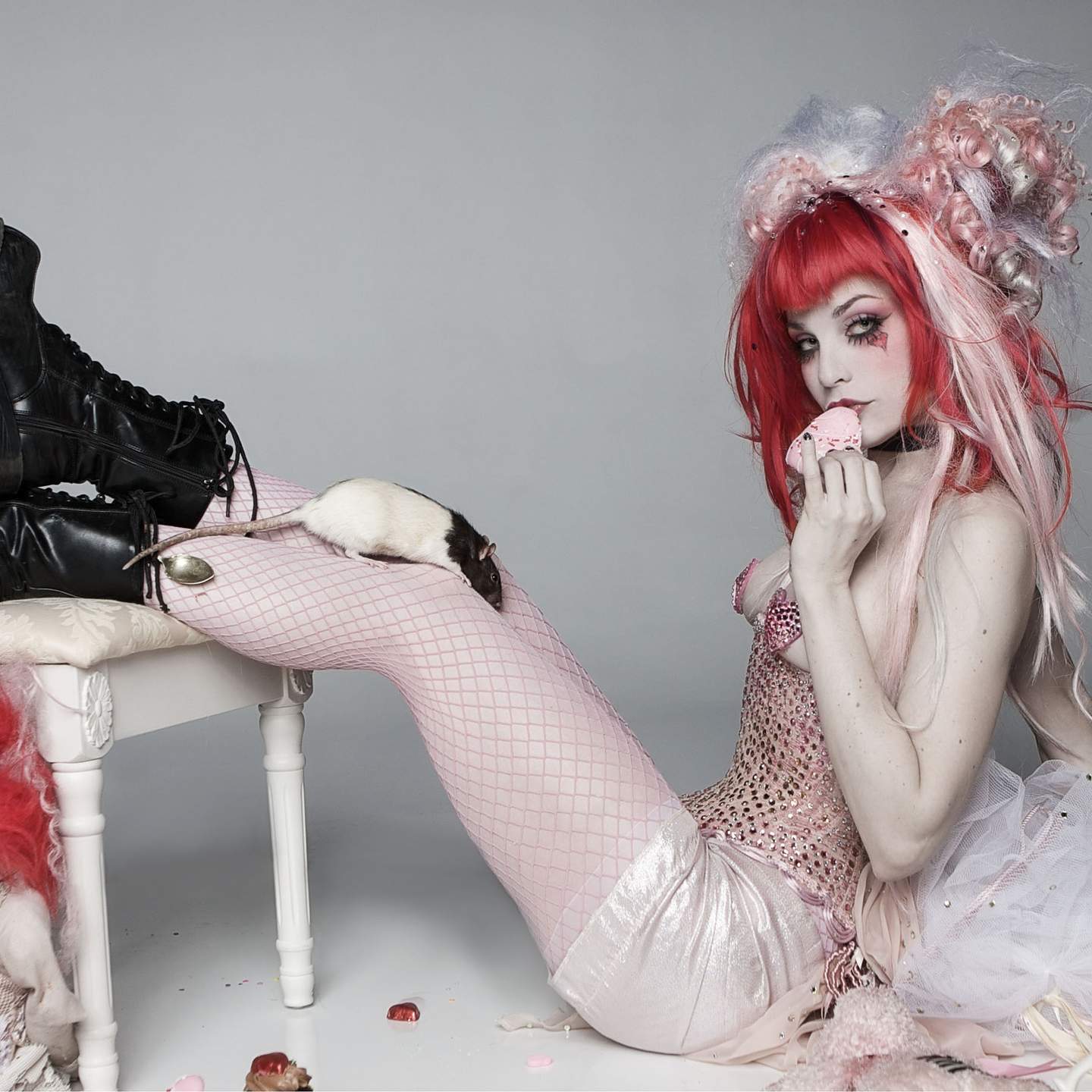
Emilie Autumn Liddell, aged 46, is an American singer-songwriter, poet, blogger, author, and violinist. Her musical genre has been described by herself as "Fairy Pop" and "Victoriandustrial" to best encapsulate her works' sound. Other accurate genre names for her work are terms such as chamber pop, industrial, classical, dark cabaret, and showtunes-esque music. Her work was most popular in the 2000s and 2010s, but she continued making music over the years. Some examples of her most popular albums include Opheliac (2006), Enchant (2003), and Fight Like A Girl (2012).
Her musical style and lyrical content is most inspired by history, poetry, literature, Shakespeare’s female characters, and fairytales. Her main inspiration, however, is the Victorian Era, especially the lunatic asylums from that time and the more recent Steampunk aesthetic. Her music sometimes reflects the era’s style, her Enchant album from 2003 is R&B esque. 2006’s Opheliac has an edgier style, which reflects the early and mid 2000s well with its counter-culture trends. However, her musical style itself is inspired specifically from the Victorian era, and the themes are typically from Shakespeare and fairytales in her earlier works especially. The instrumentation is a blend of past and present, with both electronic industrial music and keyboard as well as violin and cello, with theatrical vocals.
She worked with Baroque violin to make instrumental works, recording both covers of songs from Baroque composers such as Bach as well as her own original pieces. She plays the harpsichord and piano. She also does the digital programming required for her songs herself. Her music is largely a mixture of digital and classical instruments. She also plays the viola (which she states she learned purely so she could play Bach’s Brandenburg 6th) and the treble viola da gamba.
The two standout pieces I picked as a representation of her output are "Opheliac" and "Nothing." I picked Opheliac as it is the titular song in her most well-known and iconic album, Opheliac. It showcases her overall style, as well as the themes she uses. The instruments used are harpsichord, violin, and some virtual instruments for the beat and sound effects. The tempo shifts wildly between fast and slow sections, with the fast parts being fortissimo and slow parts sounding piano. The form is likely ternary, due to it's contrasting sections: the verses, pre-choruses, and choruses remain the same, while the bridge acts as a contrasting section before the final chorus. As for the harmony, it sounds like it is diatonic, based on a certain key, with chromatic variations interspersed for the sake of intensity and drama. The harmonies and melodies are not easily definable, at least to me, which symbolizes the chaotic and unconventional nature of her music.
The second standout piece, "Nothing," is from her album The Asylum For Wayward Victorian Girls: Behind the Musical. It grew in popularity online and is her most streamed song on Spotify. The album is also very different from Opheliac and all of her other works. In contrast to "Opheliac," the instrumentation is very simple, using primarily violin and perhaps minimal digital sound effects. The beat starts simple and pianissimo and grows more complex and fortissimo as the end of the song comes, but then drop out entirely in favor of just vocals at the very end. The notes are long and drawn out for suspense and intensity. The form appears more binary as there is no true return to the original form, it simply contains Stockill's perspective and then Emily's perspective through musical sections. I also do not think there is a specific melody/harmony, as it sounds a bit dissonant for the sake of creating tension.
Emilie was born on September 22, 1979 to costume designer Janice Longmire and German immigrant Wolfgang Fritzges. She was raised in Malibu, California. She began playing violin at age four, and as she stated on her blog on September 24, 2001, she “played notes before [she] could read.” She began performing professionally as a classical violinist at age 12, leaving school to pursue music. At fifteen, she went to the University of Music in Bloomington, Indiana. However, she left after only two years because she felt she needed more artistic freedom and disliked the rigidity of the University.
In 1995, at age 16, she began making her own music – working on a future album, Enchant.
In 1997, she released her first instrumental album On A Day: Music for Violin and Continuo, when she was 17 years old. It is titled that because the album only took a day to record.
In 2001, she officially launched her own independent label, Traitor Records. On her blog, on September 11th, 2002, she stated the label was made “for the purpose of releasing my albums without having to answer to major label record company executives. Traitor Records embraces the Internet’s potential for low cost, high volume marketing.” On this label, she released the Chambermaid EP, followed by her single "By The Sword.” Interestingly, she stated on September 24, 2001, that the single was written and recorded three hours after she had heard about the events of 9/11. She did not want to be around others, nor deal with going to the studio, so she used what she “had at home: a free, 8-track version of Pro-Tools, a keyboard, my violin, and my voice.”
In 2003, she released the Enchant album after leaving Seraph Records.
In 2004, she collaborated with Courtney Love in 2004 on her America’s Sweetheart album, playing violin.
2006 saw the release of the iconic Opheliac album, having a vastly different style than her previous albums. She stated that the change was due to her previous stay in a mental hospital after a suicide attempt, but her claims on this subject are inconsistent at best — as she has also stated that her stay took place after Opheliac. Regardless, a stay (or stays) in a Los Angeles mental hospital that occurred anytime between the years 2004-2007 drastically shifted the subject matter of her work toward darker themes and a reliance on Victorian insane asylum imagery. According to EA, she was diagnosed with bipolar disorder around this time, at 27 years old.
2007 saw Laced/Unlaced, a two-disc instrumental album. Laced featured songs performed on a Baroque violin, and Unlaced featured songs performed on an electric violin, as well as some largely electronic works.
Emilie has stated in multiple interviews that her bipolar disorder heavily influences her music. Her manic episodes helped a lot of music she made even be created, as she once detailed in a post how she couldn’t even remember writing or creating her Laced/Unlaced album, as she made much of her work during a long manic episode. She also frequently mentions pulling long nights to finish her recordings. Mental illness and her experiences with it remains as a main influence of her lyrical content.
In 2010, Autumn released a semi-autobiographical novel entitled The Asylum For Wayward Victorian Girls, a work supposedly detailing while also fictionalizing her experiences in a mental hospital. The novel is based on a secret journal she kept while staying there. The veracity of it is heavily debated, as it seems highly dramatized. She details the abuses she experienced at the hands of nurses and doctors, and states that the experience left her traumatized. Shortly after the release of her novel, she got a tattoo that reads “W14A,” or, the number she claims to have been assigned during her mental hospital stay.
Recorded between 2010 and 2012 was the album entitled Fight Like A Girl, which served as a musical companion to her previous novel to elaborate on the story.
In 2018, she released The Asylum For Wayward Victorian Girls: Behind The Musical, an album featuring songs from an in-the-works musical theatre adaption of her semi-autobiographical novel. The musical is still considered to be in pre-production.
Her latest released song is a 2021 single called The Passenger, a cover work originally by Iggy Pop.
Despite going silent on most social media and blogs for several years, Emilie has recently become active again on her official website, making a weekly blog post about how to “stay stark raving sane” and “live wildly and well.” She also has created "The Key and Doors Method", which is a workbook created "to manage bipolar disorder, PTSD, and chronic autoimmune disease," according to her website.
Emilie, in my personal experience, seems to remain relatively unknown. Popular at one point in time, she is instead rather niche today, perhaps more known to millennials who had any sort of goth phase. Within the fandom, she is known for her many controversies. Decidedly unique in her costumes, aesthetics, and musical and vocal style, and pioneering her own wild, chaotic genres, she is at least a huge inspiration to me personally.